DR FARHAN EXPLAINS — CLINICAL SERIES
Premium Clinical Algorithm Guide
Caries Activity vs Arrest — Decision Tree Protocol
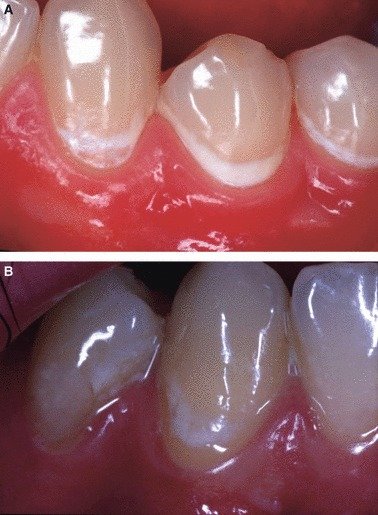
🦷 Visual Orientation — Active vs Arrested Lesion Patterns
FRONT MATTER
Series Branding
Dr Farhan Explains – Clinical Series
Algorithmic • Evidence-Based • Chairside-Executable • Exam-Safe
Professional Foreword
Modern cariology requires more than detecting lesions — it requires determining lesion behavior. Whether a lesion is active or arrested directly determines urgency, recall interval, preventive intensity, and operative threshold. Misclassification leads to overtreatment, undertreatment, and medicolegal vulnerability.
Activity assessment is a structured clinical judgment based on surface characteristics, plaque ecology, lesion location, and texture, not color alone and not radiographic depth alone. This guide converts established activity criteria into poster-ready decision trees and reproducible chairside algorithms suitable for postgraduate exams and specialist practice.
The central rule:
Activity determines urgency. Arrest determines monitoring.
This guide operationalizes that rule.
How to Use This Guide
Use in three operational modes:
Chairside Mode — Follow decision trees during clinical exam
Exam Mode — Use examiner notes and scoring thresholds
Teaching Mode — Use posters and matrices for instruction
Each protocol block includes:
Stepwise algorithm
Flowchart logic text
Decision triggers
Numeric thresholds
Contraindications
Failure pathways
Viva defense lines
Documentation requirements
Icon Legend System
🔴 Red Flag — Immediate escalation indicator
🦷 Chairside Tip — Practical clinical shortcut
⚠️ Medicolegal — Documentation critical
📘 Examiner Note — Viva scoring phrase
❌ Pitfall — Frequent diagnostic error
CORE CONTENT — ALGORITHM SYSTEM
SECTION 1 — Concept Framework: Activity vs Arrest
Algorithm 1 — Behavior-Based Lesion Classification
Lesion detected →
Surface evaluated after cleaning + drying →
Shows demineralization signs →
Proceed to activity assessment →
Classify lesion behavior →
Active disease
Arrested disease
Chairside Narration
Lesion stage (ICDAS) describes severity.
Lesion activity describes current disease dynamics.
Treatment planning is driven more by activity than by color or size in early disease.
📘 Examiner Note
“Stage describes extent — activity describes behavior.”
❌ Pitfall
Using ICDAS score alone to decide activity.
SECTION 2 — Primary Activity Decision Tree (Clinical Gold Standard)
Algorithm 2 — Master Activity vs Arrest Flowchart
Clean tooth →
Dry 5 seconds →
Good illumination →
STEP 1 — Surface Luster →
Matte / dull → Active bias
Shiny / glossy → Arrested bias
STEP 2 — Surface Texture (ball probe sweep) →
Rough → Active bias
Smooth → Arrested bias
STEP 3 — Plaque Stagnation Zone →
Present → Active bias
Absent → Arrested bias
STEP 4 — Gingival Proximity →
≤1 mm → Active bias
>1 mm → Arrested bias
STEP 5 — Surface Hardness →
Soft / leathery → Active
Hard → Arrested
Majority rule → Final classification
Chairside Narration
Activity is a multi-parameter decision, not a single sign:
Luster = mineral surface state
Texture = surface breakdown
Location = biofilm environment
Hardness = structural integrity
🔴 Red Flag
Soft surface + plaque stagnation = high activity probability.
SECTION 3 — Site-Specific Activity Algorithms
Algorithm 3 — Smooth Surface Lesions
Smooth surface lesion →
Near gingival margin? →
YES → Activity probability ↑
NO → Evaluate texture + luster →
Matte + rough → Active
Shiny + smooth → Arrested
🦷 Chairside Tip
Gingival third lesions are rarely inactive if plaque present.
Algorithm 4 — Occlusal Lesions
Fissure lesion →
Fissure plaque-retentive? →
YES → Active bias
NO → Arrested bias →
Matte + chalky → Active
Dark + shiny → Arrested
❌ Pitfall
Assuming all dark fissures are carious and active.
Algorithm 5 — Root Surface Lesions
Root lesion →
Probe gently →
Soft / leathery → Active
Hard / scratchy → Arrested
🔴 Red Flag
Soft root lesion in xerostomia = rapid progression risk.
⚠️ Medicolegal
Root caries activity must be documented explicitly.
SECTION 4 — Supportive (Non-Primary) Indicators
Algorithm 6 — Color Interpretation Rule
Color observed →
White/yellow → Supports activity
Brown/black → Supports arrest
BUT →
Never decide activity by color alone
📘 Examiner Note
Color = supportive, not diagnostic.
❌ Pitfall
“Brown = arrested” — not always true.
Algorithm 7 — Radiographic Modifier Rule
Radiolucency present →
Indicates depth →
Does NOT indicate activity →
Must correlate clinically
📘 Examiner Note
Radiographs show extent, not behavior.
SECTION 5 — Activity Scoring Matrix Protocol
Activity Scorecard Table
Assign 1 point each:
| Feature |
Active Sign |
| Matte surface |
+1 |
| Rough texture |
+1 |
| Plaque stagnation |
+1 |
| Gingival proximity |
+1 |
| Softness |
+1 |
Threshold Rule
| Score |
Interpretation |
| 0–1 |
Likely arrested |
| 2–3 |
Uncertain — review |
| 4–5 |
Active |
🦷 Chairside Tip
Use scorecard in borderline cases.
SECTION 6 — Management Pathway Integration
Algorithm 8 — Action Based on Activity
Lesion classified →
ACTIVE →
Non-cavitated → Remineralize
Cavitated → Restore
ARRESTED →
Monitor
Extend recall
Recall Interval Threshold Table
| Activity |
Risk |
Recall |
| Active |
High |
3–4 months |
| Active |
Moderate |
6 months |
| Arrested |
Low |
12 months |
🔴 Red Flag
Active lesions without preventive plan = management failure.
VISUAL LOGIC BLOCKS
Poster Flow — Activity Decision
Clean → Dry → Luster →
Texture →
Plaque zone →
Gingival distance →
Hardness →
Score →
Active vs Arrested
Active vs Arrested Matrix
| Parameter |
Active |
Arrested |
| Luster |
Matte |
Shiny |
| Texture |
Rough |
Smooth |
| Plaque |
Present |
Absent |
| Hardness |
Soft |
Hard |
| Location |
Stagnation |
Cleansable |
Severity vs Activity Grid
| Stage |
Active |
Arrested |
| Early |
Prevent |
Monitor |
| Moderate |
Intensive prevent |
Monitor |
| Cavitated |
Restore |
Restore/monitor |
=============================
CLINICAL CALLOUT BOXES
=============================
🔴 Red Flags
Soft root lesion
Multiple active white spots
Xerostomia + active lesions
Rapid change since last visit
⚠️ Medicolegal
Record activity status
Record criteria used
Record recall interval
Record preventive plan
📘 Examiner Notes
Activity overrides color
Hardness is key discriminator
Radiograph cannot define activity
❌ Pitfalls
Color-only diagnosis
No drying before exam
Sharp explorer force
Ignoring plaque environment
APPENDICES & POSTER PACK
Appendix A — Chairside Activity Worksheet
Fields:
Tooth number
ICDAS stage
Luster
Texture
Hardness
Plaque zone
Score
Activity status
Plan
Appendix B — Activity Scorecard Pad (Printable)
Rapid tick-box scoring sheet.
Appendix C — Active vs Arrested A3 Poster
Full decision tree + matrix.
Appendix D — Root Caries Activity Poster
Hardness-based decision chart.
Appendix E — Examiner OSCE Sheet
Checklist:
Drying mentioned
Luster assessed
Texture assessed
Hardness assessed
Decision justified
Appendix F — Quick Reference Pocket Card
Two-sided chairside card.
REFERENCES — VANCOUVER STYLE
Fejerskov O, Kidd E. Dental Caries: The Disease and its Clinical Management. Wiley Blackwell.
Nyvad B, Baelum V. Clinical criteria for caries lesion activity. Community Dent Oral Epidemiol.
Pitts NB, Ekstrand KR. ICDAS criteria. Community Dent Oral Epidemiol.
Ekstrand KR, Ricketts DNJ. Visual and radiographic detection studies. Caries Res.
Featherstone JDB. The caries balance concept. Caries Res.
Zero DT. Caries process and activity assessment. J Dent Educ.
FINAL ASSEMBLY LAYER
Page Assembly Map
1 Cover
2 Foreword
3 How to Use
4 Legend
5–18 Core algorithms
19–30 Matrices & tables
31–45 Posters
46–60 Worksheets
61+ References
Canva / InDesign Blueprint
Typography
Headings — Montserrat Bold
Body — Source Sans
Tables — Roboto Condensed
Color System
Navy — Core
Teal — Evidence
Red — Red Flag
Green — Chairside
Amber — Pitfall
Export Specs
Print — A4 + A3, CMYK, 300 DPI
Digital — Interactive PDF, bookmarked, poster zoom pages
Gumroad Product Description
Caries Activity vs Arrest — Decision Tree Protocol
A complete clinical algorithm system for distinguishing active vs arrested caries using evidence-based criteria, chairside scorecards, OSCE-ready decision trees, and poster-grade visual matrices for postgraduate and specialist training.
Deliverables
Premium PDF guide
Poster pack
Activity scorecards
Chairside worksheets
OSCE examiner sheets
Pocket cards
Pricing Strategy
Single Guide — Premium
Caries Algorithm Bundle — Value
Teaching License — Institutional
Bundle Strategy — Cross-Sell
Pair with:
Caries Risk Assessment Guide
Restore vs Monitor Algorithm Guide
Minimal Intervention Dentistry Protocol
Operative Threshold Master Guide
 For Dental Students & Professionals